

Te Wānanga o Aotearoa Modernises Apple Device Management with a Cloud-First Jamf Environment - Case Study
Te Wānanga o Aotearoa Modernises Apple Device Management with a Cloud-First Jamf Environment
Te Wānanga o Aotearoa is one of New Zealand’s largest tertiary education providers, supporting learners across the country through a network of campuses and learning locations. With a geographically dispersed workforce and hundreds of Apple devices in use nationwide, maintaining a modern, scalable device management environment is essential to ensuring staff have secure, reliable access to the technology they need.
As cloud-based management platforms continue to evolve, Te Wānanga o Aotearoa identified an opportunity to modernise its Apple device management environment and position itself for future growth.
The Challenge
Te Wānanga o Aotearoa manages a fleet of approximately 300 Apple devices distributed across multiple locations throughout New Zealand. Their existing Jamf Pro environment was hosted on-premises, limiting access to newer cloud-based functionality and creating barriers to further modernisation.
While moving to Jamf Cloud presented clear advantages, traditional migration approaches would have required significant effort to physically engage with hundreds of devices spread nationwide. Te Wānanga o Aotearoa needed a practical way to modernise its Apple management environment while minimising disruption to staff and learners.
The Solution
Cyclone worked closely with Te Wānanga o Aotearoa to assess their options and develop a migration strategy aligned with their long-term goals. Rather than simply replicating their existing environment in the cloud, Cyclone’s Apple and Jamf specialists identified an opportunity to redesign and modernise the platform using current best practices.
Cyclone provided guidance, technical consulting, and access to a Jamf Cloud trial environment, allowing Te Wānanga o Aotearoa to evaluate the platform and begin building a new management framework. Through collaborative planning with both Te Wānanga o Aotearoa and Jamf, a migration approach was developed that enabled the organisation to run both environments in parallel, giving them the flexibility to transition devices progressively and on their own timeline.
Bringing the Risk to Life
For organisations with geographically dispersed Apple fleets, a device management migration can quickly become complex. Re-enrolling hundreds of devices, maintaining user productivity, and ensuring consistent policies across multiple locations all require careful planning.
Without a clear strategy, organisations can face extended project timelines, operational disruption, and the risk of simply transferring legacy configurations into a new environment.
By taking a consultative approach, Cyclone helped Te Wānanga o Aotearoa turn a necessary platform migration into a broader modernisation initiative, creating the foundation for a cleaner, more scalable device management environment that supports future growth.
Outcomes
With support from Cyclone, Te Wānanga o Aotearoa is successfully transitioning from an on-premises Jamf Pro environment to Jamf Cloud while implementing a refreshed management framework built on modern best practices.
The collaborative approach provided Te Wānanga o Aotearoa with:
- A clear roadmap for cloud adoption
- Access to the latest Jamf Cloud capabilities
- A modernised and future-ready Apple management environment
- Flexibility to migrate devices progressively across multiple locations
- Ongoing access to Apple and Jamf expertise throughout the transition
The result is a more scalable and efficient platform that will support the ongoing management of Apple devices across Te Wānanga o Aotearoa’s nationwide operations.
“Cyclone’s guidance helped us look beyond a simple migration and consider how we could improve our entire Apple management environment. Their expertise, practical advice, and collaborative approach gave us confidence to move to Jamf Cloud in a way that aligned with our long-term goals.”
– Te Wānanga o Aotearoa


Case Study: Working with Selwyn House
Case Study: Working with Selwyn House
Selwyn House School, a Christchurch based Yr1-8 school delivering the International Baccalaureate PYP program, partnered with Cyclone to refresh their student iPad fleet in December 2025
Collaborating closely with their Cyclone Account Manager and our Apple Education Specialist, Selwyn House selected the 7th generation iPad Air with the M3 Apple Silicon chip as the preferred device to empower student creativity and learning. Having previously purchased 9th generation iPads, the decision to select the iPad Air unlocked more power, a new form factor and the option to use Apple Intelligence for secure, on-device Artificial Intelligence.
As part of this refresh, Cyclone provided expert consulting to the school’s Head of ICT to fine tune their Jamf MDM configuration profiles ahead of the deployment of these new iPads.
Get in Touch
- Interested in learning how you can have a similar experience with an iPad refresh? Reach out to the Cyclone team today!

Technology Inflation: Why Schools Can’t Afford to Wait
Technology Inflation: Why Schools Can’t Afford to Wait
For decades, technology procurement has benefited from a simple assumption: if you wait long enough, devices become faster, better and often cheaper.
Today, that assumption is being challenged.
Schools across New Zealand are facing a technology market that looks markedly different from the one we have become accustomed to. Global demand for artificial intelligence (AI) infrastructure, ongoing semiconductor constraints, and increasing pressure on memory and storage supply chains are creating a new reality where technology costs are rising, lead times are becoming less predictable, and delaying purchasing decisions may carry significant financial risk.
“For school leaders, business managers and boards, this is not simply an IT challenge. It is increasingly a governance and financial planning issue.”
What's Driving the Change?
Much of the current market pressure stems from unprecedented global investment in AI infrastructure. The world’s largest technology companies are investing billions of dollars into data centres that require enormous volumes of memory and storage components. Manufacturers are naturally prioritising these higher-margin products, redirecting capacity away from the components that power mainstream laptops, desktops, Chromebooks, and servers.
Industry analysts are describing this as more than a temporary shortage.
“Unlike the disruption experienced during COVID-19, many experts believe the current market reflects a longer-term reallocation of manufacturing capacity rather than a short-term supply shock.”
New semiconductor manufacturing facilities take years to build, meaning relief is unlikely to arrive quickly.
The result is straightforward: higher component costs are flowing through the supply chain and into the price of end-user devices and infrastructure. While technology will continue to evolve rapidly, the expectation that prices will continue to fall year after year can no longer be taken for granted.

Why This Matters for Schools
Schools are particularly exposed to these market dynamics.
Most schools maintain large fleets of student and staff devices, alongside increasingly sophisticated digital infrastructure. Classroom learning, assessment, administration, cybersecurity, communications, and student wellbeing initiatives all rely heavily on technology. Whilst a modest increase in the cost of a single device may seem manageable, when multiplied across hundreds or even thousands of devices, the budgetary impact becomes significant.
The challenge extends beyond laptops and student devices. Schools planning server upgrades, storage expansion, wireless network improvements, or cybersecurity investments may also find these projects becoming more expensive as memory and component costs continue to rise.
At the same time, many schools are operating within tightly managed budgets and competing priorities. Unexpected increases in technology costs can force difficult decisions around project timing, refresh cycles, and capital allocation.
Rethinking Procurement Strategy
The schools best positioned to navigate this environment will not necessarily be those with the largest budgets. It will be those with the most deliberate procurement strategies.
One of the most common challenges we see is reactive technology replacement. Devices are often refreshed when they become a problem rather than when they reach a planned lifecycle milestone. This can result in procurement decisions being made under pressure, often at the least favourable point in the market.
Instead, schools should be viewing technology procurement through a longer-term lens.
A practical starting point is the development of a rolling 36-48 month technology roadmap that identifies major refreshes, infrastructure upgrades, and anticipated growth requirements. This enables school leadership teams to understand future budget exposure and make informed decisions about timing.
In some cases, bringing planned purchases forward may be financially advantageous.
“Securing pricing ahead of anticipated increases can provide greater certainty and help avoid the impact of future supply constraints.”
Just as importantly, it can reduce the risk of reaching a point where critical devices or infrastructure need replacing when market conditions are most challenging.
Schools should also consider whether traditional capital purchasing remains the best model for every investment. Leasing, lifecycle funding, or vendor-backed financing arrangements can sometimes provide flexibility by allowing schools to secure today’s pricing while aligning payments to future budget cycles. While financing is not the right answer for every organisation, it can be a useful tool when incorporated into a broader asset lifecycle strategy.
Planning Is the New Cost-Saving Strategy
For many years, the cheapest technology strategy was often to wait. Increasingly, the opposite may be true.
“The greatest risk facing schools is not necessarily paying more for technology; it is being forced into reactive purchasing when options are limited, budgets are constrained, and prices have already moved higher.”
As boards and leadership teams consider future budgets, now is an opportune time to review planned technology investments and assess whether action today could reduce costs tomorrow.
Practical actions schools can take now:
- Review planned device and infrastructure refreshes over the next 24–36 months.
- Engage Boards and finance committees early to determine whether capital can be brought forward where appropriate.
- Consider accelerating major refresh programmes and utilising secure warehousing and staged deployment options through a trusted technology partner.
- Explore leasing, lifecycle funding, or vendor-backed bridging finance solutions that enable pricing to be secured today while aligning payments to future budget cycles.
- Work closely with your technology partner to understand supply chain trends, procurement timing opportunities, and potential risks before major purchasing decisions are required.
In a market where technology costs are no longer predictably falling, strategic planning may prove to be the most valuable procurement tool schools have.
Get In Touch
If you’d like to set your school up for success, reach out to your Cyclone Account Manager or contact our team using the button below.

The Impact of Generative AI in New Zealand Schools
The Impact of Generative AI in New Zealand Schools
Written by Danny Bedingfield
An article by Danny Bedingfield, a Learning, Development and AI Specialist at Cyclone, working with schools across Aotearoa to support safe, practical and effective use of digital technologies.
Over the past three years, I have had the privilege of working alongside teachers, leaders and IT teams across the country as generative AI has moved from a novelty to an everyday tool. In this article, I will explore the impact of generative AI in New Zealand schools, with a clearer view of where we are now in 2026, and what matters most moving forward.
What has changed
When generative AI tools like ChatGPT first appeared, they were largely seen as standalone tools that people could choose to explore. That is no longer the case.
Today, AI is embedded directly into the platforms schools already use every day:
- Microsoft 365 Copilot and Copilot Chat across Word, Outlook, Teams and more
- Google Gemini integrated into Workspace for Education
- Apple Intelligence built into supported Macs, iPads and iPhones, with a strong on-device focus
This shift is significant. Schools are no longer deciding whether to use AI. They are deciding how to use it safely and effectively within tools that are already part of their environment.
A quick note on AI tools and data protection
One of the biggest areas of confusion for schools is the difference between consumer tools and enterprise-grade platforms.
In simple terms:
- Consumer tools are typically free and publicly available. These may use prompts and data to improve their models, and are not designed with school-level governance in mind
- Enterprise or education versions are designed for organisations, offering stronger controls, data protection and administrative oversight
For schools, this distinction matters.
Platforms such as Microsoft 365 Copilot, Copilot Chat (when signed in), Google Gemini for Workspace, and Apple Intelligence are designed with data protection in mind when correctly configured. However, this protection depends on licensing, identity management and admin settings, not just the name of the tool.
The key takeaway is simple. Do not assume a tool is safe because it is familiar. Always check how it is configured in your environment.
The opportunity for teaching and learning
Despite the noise, one thing has become clear. Generative AI offers real, practical value in schools when used well.
Across Aotearoa, I am seeing teachers use AI to:
- generate lesson ideas and unit plans
- create differentiated resources more quickly
- support students with writing, feedback and revision
- explore new ways to personalise learning
Students are already using these tools as well, often outside of school hours. That is an important shift.
The question is no longer whether students will use AI. The question is whether schools will help them use it well.
Used thoughtfully, AI can:
- reduce teacher workload
- increase access to learning support
- enable more personalised and inclusive learning experiences
But these benefits only appear when AI is guided, reviewed and used with intent.
The risks are still real
-
Academic integrity
Students can generate work that is not their own. Schools need clear expectations around what is acceptable, especially for assessment -
Accuracy and bias
AI can produce content that sounds convincing but is incorrect or culturally incomplete. Critical thinking remains essential -
Privacy and data protection
Any personal or sensitive information entered into AI tools must be handled in line with the Privacy Act 2020 -
Equity of access
Not all students have equal access to devices or AI tools outside of school, which can create new gaps if not considered
The growing policy and guidance landscape
One of the biggest changes since this article was first written is the amount of guidance now available.
In Aotearoa, schools can draw on:
- The Privacy Act 2020 as the foundation for data handling and protection
- Ministry of Education guidance on generative AI use in schools
- NZQA updates on AI and assessment integrity
This means schools no longer need to navigate AI in isolation. There is enough guidance now to support informed decision making, even if it continues to evolve.
Why an AI strategy matters
One of the biggest risks I still see is unstructured adoption.
Teachers experimenting individually is valuable, but without a shared direction it can lead to inconsistency, confusion and increased risk.
Schools that are doing this well are taking a more deliberate approach:
- developing an AI or Responsible Use Policy, often as part of their existing Acceptable Use Agreement
- involving Senior Leadership Teams, IT, teachers and sometimes students in the process
- providing staff training and practical examples of good use
- reviewing and updating regularly as tools and guidance change
This does not need to be a complex, 40-page document. What matters is clarity.
Teachers need to know what is okay, what is not, and where judgement is required.
Augment, not replace
Perhaps the most important message has not changed.
AI should support teaching, not replace it.
Great teaching is built on relationships, cultural understanding, context and professional judgement. These are things AI cannot replicate.
What AI can do is remove friction.
It can help teachers get to a first draft faster.
It can help generate ideas when time is short.
It can support learners when a teacher cannot be there in the moment.
But the heart of education still sits with people.
Setting the course
Generative AI is now part of the fabric of education in Aotearoa. Ignoring it is no longer realistic, and unstructured use is no longer safe.
The schools that will benefit most are those that:
- prioritise data protection and privacy from the start
- choose tools and configurations carefully
- develop clear, shared expectations for use
- invest in AI literacy for both staff and students
- treat AI as a capability to be built, not just a tool to be used
If we take this approach, AI becomes something far more powerful than a shortcut.
It becomes a way to give teachers back time, support learners more effectively, and build the critical thinking skills our students will need in an AI-enabled world.
Kia kaha as you explore this space with your teams and communities.
Art Gallery Case Study
Art Gallery LED Display Upgrade - Case Study
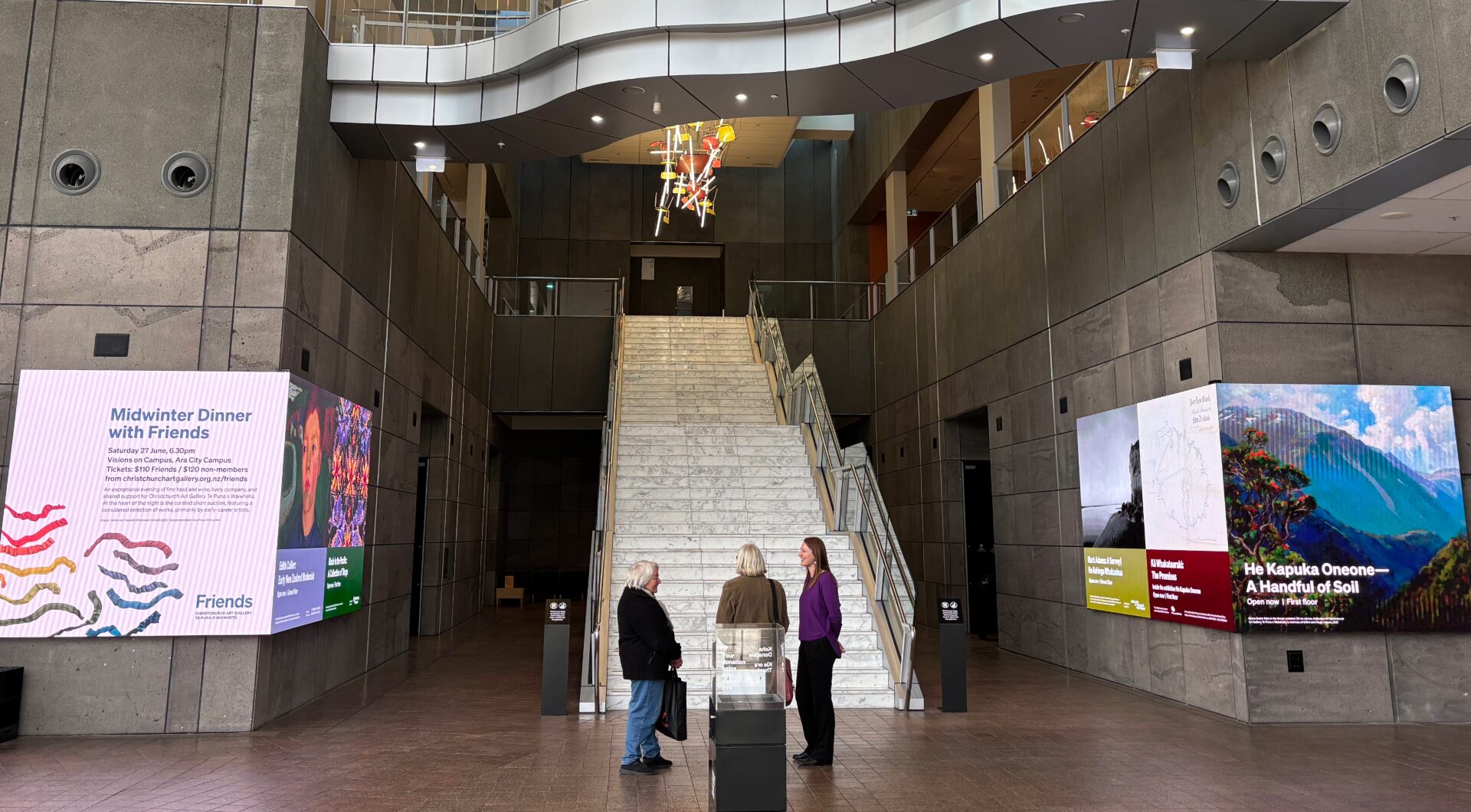
Cyclone was selected by the Christchurch Art Gallery to enhance their large-scale display installation, improving visual quality and creating a more immersive viewing experience for visitors.
The Challenge
The pre-existing video wall consisted of 18 x 55” display panels on each side. The setup had several limitations that impacted overall effectiveness.
Visible bezels between panels disrupted the image and reduced visual impact. In addition, the reflective surface made it difficult to maintain visibility in the bright gallery environment, limiting the overall viewing experience.
Together, these factors took away from the intended impact of the content and limited the quality of the viewing experience.
The Solution
To address these challenges, Cyclone designed a solution focused on seamless visual delivery and performance in a high-light environment.
Cyclone supplied and installed a TaylorLED COB (Chip On Board) solution, designed to overcome the limitations of traditional panel-based displays.
The new solution included:
- Two LED walls, each 6.6m long x 2.4m high
- Super fine pixel pitch of 0.9 for high-resolution
- A total resolution of 7040 x 2520
- Smartsign digital software for a pixel-to-pixel match
- High brightness (1000 nits) suited to a bright gallery environment
- Custom 90-degree corner configuration to enable content to wrap cleanly and provide seamless image quality.
- To ensure ease of use and flexibility, the system was integrated with a control solution enabling:
- Manual brightness adjustment for varying conditions. This allows Art Gallery staff to select the brightness they want, especially useful during night-time events.
- Simple laptop connection for easy content presentation. This overrides the normal digital signage content presentation.
This transformed the display from a segmented video wall into a fully integrated digital experience.
Enhancing the Viewing Experience
The new LED installation has significantly improved how content is viewed and experienced within the gallery.
Visitors now engage with a seamless, high-quality visual environment designed to support immersive storytelling. At the same time, the gallery benefits from a system that is easier to manage, more adaptable, and better suited to a wide range of events and use cases.
Audio Visual Expertise
Delivered by Cyclone’s specialist AV team, this project reflects a considered approach to design, installation and ongoing usability – ensuring the technology supports the space without adding complexity.
If you would like to explore how our AV solutions could enhance your organisation, please reach out to the Cyclone team.
Allied Media Case Study
Protect: People Case Study - Allied Media
Allied Media engaged Cyclone to strengthen their human firewall by implementing Protect: People, a fully managed security awareness and phishing simulation service. The programme covers over 300 users and focuses on reducing the risks caused by human behaviour.
“What stood out with Protect: People is the continuous approach. Rather than one-off training, we’re seeing ongoing improvement in how our people identify and respond to threats. It’s helping us build a stronger security culture across the organisation.”
– Timo Janssen, CITO, Allied Media
The Challenge
Like many organisations, Allied Media recognised that phishing and social engineering remain one of the most effective attack methods. They needed an approach that would:
- Build practical, lasting user awareness
- Reflect real-world attack scenarios
- Deliver measurable improvement over time
- Be simple to manage and scale
The Solution
Cyclone implemented Protect: People, a continuous, managed security awareness programme combining:
- Baseline phishing simulation to establish user behaviour and awareness
- Ongoing phishing simulations with quarterly spear-phishing simulations
- Behaviour-led localised online training
- A personalised training session
- Ongoing reporting to track engagement and behavioural improvement
- End-to-end programme management with no additional management required by the customer
This enabled Allied Media to move beyond one-off training to a structured, measurable awareness programme.
Bringing the Risk to Life
As part of the programme, Cyclone delivers a quarterly targeted spear‑phishing simulation designed to reflect realistic attack scenarios.
In one campaign, users received an email offering a free coffee from a local café. The message included a link prompting users to log in to redeem the offer – mimicking a highly believable, localised phishing attempt.
Some users clicked the link and submitted their details, highlighting how easily even well‑intentioned employees can be caught by highly credible, real-world attacks. Some users took it a step further, even going to the café to redeem their ‘free’ coffee.
This example provided a powerful learning moment, helping users to:
- Recognise suspicious links and login prompts
- Better understand how attackers use familiarity and incentives
- Apply critical thinking before engaging with unexpected offers

Strengthening the Human Firewall
Over time, Allied Media has seen a measurable shift in user behaviour and awareness, with employees better equipped to recognise and respond to potential threats. By embedding security awareness into everyday activity, the programme has helped move cyber security from a one-off exercise to an ongoing, practical discipline across the organisation.
If you’re looking to take a more proactive approach to protecting your people, get in touch with Cyclone to see how Protect: People can support your organisation.
Learn More with Cyclone
If you would like to explore how Protect: People could enhance your organisations technology strategy, please reach out to our Cyclone team.
Disconnected AI: Why Local Intelligence on Apple Silicon is the Next Strategic Advantage
Disconnected AI: Why Local Intelligence on Apple Silicon is the Next Strategic Advantage

Rethinking Where AI Lives
The dominant narrative around artificial intelligence has been cloud-first: APIs, tokens, and hyperscale infrastructure. While this model has enabled rapid innovation, it has also quietly introduced new risks and constraints, particularly around data ownership, cost predictability, and operational control.
A different paradigm is now emerging with the concept of Disconnected AI: running powerful large language models (LLMs) locally on modern hardware such as Apple Silicon powered Macs. What was once considered impractical is now not only viable, but increasingly strategic and exploring this shift isn’t just about achieving performance gains, it’s also about control, data sovereignty, and long-term leverage of your AI assets.
Data Sovereignty: Keeping Intelligence Close to the Source
At the heart of disconnected AI is a simple but powerful idea: your data never leaves your environment.
In a cloud-first model, every prompt, document, or dataset must be transmitted to external servers and even with enterprise-grade assurances, this introduces layers of exposure, jurisdictional uncertainty, and compliance overhead. Running AI locally changes that equation entirely:
- Sensitive corporate data stays within your infrastructure
- Regulatory compliance becomes simpler and more auditable
- Cross-border data transfer concerns are eliminated
For industries like education, finance, healthcare, and government this is a consideration that needs to be evaluated. Disconnected AI can be viewed not just as a simple technical alternative to using established cloud providers, but instead a compliance accelerator. By hosting LLM locally in a secure and disconnected environment, users can experiment, adopt and embrace AI workloads in an environment of data privacy and assured costs.
Privacy by Architecture, Not Policy
Most AI providers offer privacy guarantees, however these are always contractual and customers are dependent on the vendor to honour and deliver technically on the guarantees. Disconnected AI flips this model whereby privacy is enforced automatically by the architectural decisions, not merely by a contract between parties. When running models locally on Apple Silicon:
- No prompts are logged externally
- No training data is reused without your consent (whilst many paid Enterprise AI models make this commitment, shadow IT usage of third-party AI agents don’t make this promise)
- No third-party visibility exists in your workflows or has access to your data
Disconnected AI moves privacy from a legal promise to an architectural certainty.
This is a fundamental shift in thinking that security-conscious organisations need to consider. Instead of trusting providers not to misuse data or rely on their security defences to not be breached, exploring how Disconnected AI could enable your organisational AI workloads has the potential to eliminate this possibility altogether.
Economic Efficiency: From Opex to Capex
IT departments have, in general, been quick to embrace Opex spending models as increasing numbers of vendor solutions have introduced an “as a service” offering, providing simple, per user per month pricing models. This has empowered considerable freedom to explore new technologies at very low upfront investments but has, in the case of some cloud workloads, created significantly higher spending as consumption has soared.
In the same way, token-based pricing has made AI very accessible, but also unpredictable from a cost perspective. Costs can rapidly scale with:
- Usage volume
- Prompt complexity
- Team adoption
This creates a paradox: the more successful your AI adoption, the more expensive it becomes.
By contrast, exploring a Disconnected AI approach challenges this mentality and creates a different cost model entirely:
- One time hardware investment (e.g. Mac Studio)
- Near-zero margin cost per inference
- No ongoing token or API fees
In the current economic and technology procurement climate, Apple have bucked the trend of spiraling inflationary costs of hardware and Mac Studio and Mac Mini have become increasingly affordable choices for running Disconnected AI workloads in your own environment. Over time, this approach can dramatically reduce total cost of ownership (TCO), particularly in environments where usage scales rapidly as end users come to rely on AI-powered assistance for their daily workflows.
This provides highly predictable costs instead of highly variable bills from token-based AI providers creating a degree of ownership over the AI environment versus dependency on third party providers. Positioned a different way: with Disconnected AI usage can scale – but costs do not.
Performance and the Rise of Apple Silicon
Apple has earned many plaudits from industry analysts for their decision to build their own silicon based on ARM architecture processors and, with the rise of AI workloads, their M series chipsets have quietly become one of the most efficient AI inference platforms available. This is powered by:
- Unified Memory architecture
- High performance GPU and Neural Engine
- Exceptional power efficiency, even under load
Unlike discrete GPU systems, Apple Silicon’s unified memory allows the CPU, GPU and Neural Engine to access the same memory pool without duplication, removing a major bottleneck in model inference where weights must otherwise be copied between memory domains.
This unlocks modern Macs to run sophisticated LLMs with performance levels that are often surprising to end users. RAM requirements on Apple’s Unified Memory architecture should be considered carefully: 32GB could run 7-13B (billion) parameter models, whereas 128GB+ is required for larger models. LLM’s can range in size from lightweight (7B parameters), through to the practical sweet spot for Disconnected AI (around 13B) to the massive frontier models (70B). A 13B parameter model running on an M3 Ultra can achieve ~30 tokens/second making interactive workloads viable for knowledge workers accessing the LLM.
Beyond the Apple Silicon performance, further gains are achieved because latency drops dramatically as there is no network roundtripping of queries, offline capability becomes viable (workloads can continue with or without internet connectivity) and developers can experiment freely without cost constraints hanging over them.
As demand increases, modular scalability can be achieved very simply with macOS, whereby multiple Macs can be clustered together simply through the use of Thunderbolt cables. This effectively pools the memory and compute resources from multiple Macs, with open-source software distributing the AI workloads across the clustered hardware allowing for easy and cost-effective scaling incrementally with predictable costs based on demand.
Model Choice and Strategic Flexibility
A distinct shift has occurred with commercial AI tooling in the last six months, towards allowing end-user choice for underlying models, with examples of this prevalent in coding and generative media apps specifically. Often, however, organisations are paying only for a single generative AI application for knowledge workers, creating a degree of vendor lock-in and organisational exposure to pricing changes. By contrast, Disconnected AI unlocks the freedom to choose from various models as needed, with the ability to fine-tune performance for proprietary use-cases.
The flexibility to switch models without vendor friction is a feature of Disconnected AI, allowing experimentation to flourish as team members can test multiple models side by side and continue to iterate without incurring additional costs. This flexibility reaffirms the continued need for hybrid workloads as ultimately this is not a cloud vs local AI argument, but instead a call for intentional decision making when deploying AI workloads:
- Cloud AI for hyperscale, collaboration and external facing use cases
- Local AI for sensitive, high frequency or cost-intensive workloads
The Strategic Shift to Local Intelligence
As AI becomes embedded into an increasing number of workflows, the question is no longer what you can build, but where it runs and who controls it. This is evidenced by the increasing number of requests for proposals (RFPs) asking questions around Data Sovereignty as part of the response. Exploring Disconnected AI solutions with Apple Silicon represents a shift towards ownership over access, privacy over policy and predictability over consumption.
While local models offer strong performance for summarisation, coding assistance and retrieval tasks, they still lag frontier cloud models in reasoning depth and multi-modal capability. Critically, however, in the current economic climate with soaring compute costs for the foreseeable future, Apple have lowered the barrier to entry with their remarkable M series chipsets allowing for practical, scalable and increasingly compelling AI solutions to be run locally.
In the next phase of AI adoption, the real competitive advantage won’t just be intelligence – it will be who owns it.
Keen to learn more about Disconnected AI solutions running on Apple silicon?
Reach out to Cyclone’s Apple Practice Team.

RAMageddon - AI, Supply Chains and What It Means for New Zealand Schools
RAMageddon - AI, Supply Chains and What It Means for New Zealand Schools
Global technology markets are going through a sustained period of change. Across New Zealand, schools and kura are starting to feel this through rising device costs, fewer entry‑level options and longer lead times for technology purchases. Here’s how these changes are unfolding and why they matter for New Zealand schools.
The “Why”
At the heart of today’s technology pressure is the rapid global expansion of artificial intelligence (AI).
The data centres powering tools like ChatGPT, Google Gemini and enterprise AI platforms require enormous amounts of specialised, high‑performance memory. These components are far more profitable, global manufacturers have shifted production away from the “standard” chips used in everyday laptops, desktops and tablets.
As a result:
- Industry estimates suggest approximately 70% of global memory production is now being diverted to AI infrastructure
- Costs for standard RAM and storage rose sharply from late 2025, with some reports showing industry costs nearly doubling within a few months
- Older, lower‑cost chip designs are being retired, making some entry‑level devices harder to produce
This represents a structural shift in the market, rather than a short‑term supply disruption.
What This Means for Schools
-
Rising device costs, particularly for shared student devices, staff laptops and long‑life classroom hardware. Some schools have seen price uplifts of up to 40% across certain device categories
-
Extended or less predictable lead times, especially for large rollouts, school‑wide refreshes or multi‑site deployments
-
Increased competition for supply, as global refresh cycles (including Windows 10 end‑of‑support) overlap with tighter production capacity
Proactive Planning for Ongoing Market Pressure
Lifecycle and refresh planning
Schools with clear 12–24 month lifecycle visibility are better positioned to avoid forced upgrades under tight market conditions, supporting more deliberate and cost‑effective decisions as technology continues to quickly evolve.
Early access and pricing certainty
Current market signals suggest price pressure may persist for the next 12-18 months, particularly for standard memory‑dependent devices. Where possible, securing stock now will stabilise pricing and availability across your fleet.
Flexible finance and funding options
Many schools are exploring alternative funding and deployment models to manage cost volatility while staying within budget constraints. Funding options such as Tech Now, Pay Later, advance pricing agreements and leasing can support cashflow, budgets and purchasing cycles.
Deployment and logistics support
Partnering with a provider that can manage procurement, stock holding, imaging, configuration and staggered rollouts helps ensure devices arrive ready for learning – when you need them.
Next Steps
Technology isn’t disappearing, but it is becoming a more valuable resource that requires better planning and management.
By shifting from reactive purchasing to proactive lifecycle and funding strategies, you can stay in control of costs, timelines and performance.
Cyclone have a team of education technology experts who are happy to support you. If you’d like to review your technology roadmap, explore funding options or need assistance with deployment and logistics support, please reach out to our team today!