

What problem are we trying to solve? Lessons from the Aotearoa AI Summit
Written by Danny Bedingfield, Learning, Development and AI Specialist, Cyclone.
The Aotearoa AI Summit came to Wellington for the first time this year, running across two days at Tākina under the theme Kia whakapuāwai | Agents of Change, Powered by Curiosity. Two days of keynotes, panels and workshops later, here are the five things that resonated most with me.
1. Governance, policy, privacy and Māori data sovereignty matter more than ever
If there was a through line across both days, this was it. One of the opening slides put up the Collingridge Dilemma: we can only control technology before it is widely adopted, but we only understand its effects after adoption. That tension sat under everything that followed.
Machines predict, humans judge, and mostly we do not. AI now enters every box in the decision chain except accountability, and capability is not authority. The question worth asking in your own organisation is whether your human oversight is genuine or ceremonial, because as the Office of the Privacy Commissioner notes, people overseeing computer systems can suffer automation blindness.
Alongside that, the Human Rights Commission session on AI and digital technologies through a Te Tiriti o Waitangi lens, Peter-Lucas Jones from Te Hiku Media, and the quickfire on respecting tikanga in AI ecosystems were a reminder that Māori data sovereignty is not a nice-to-have bolted on at the end. It is a design decision made at the start.
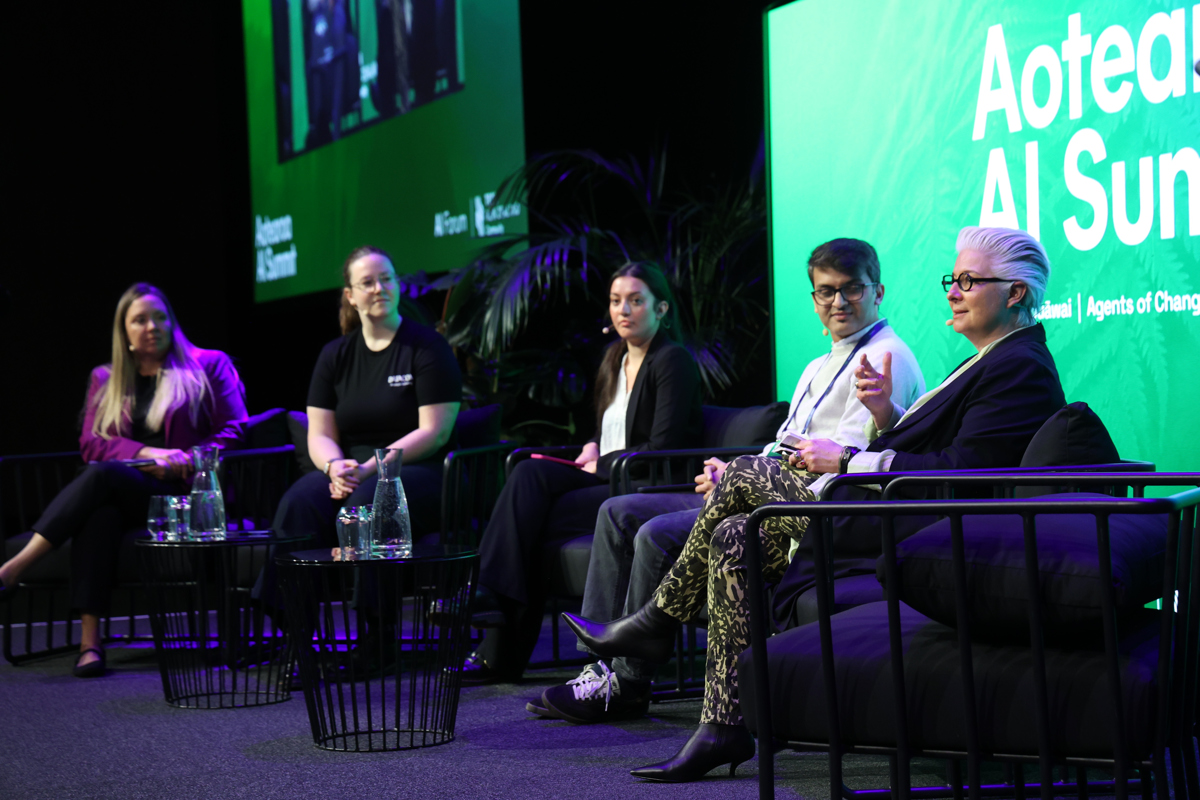
Image credit: Aotearoa AI Summit Photo Gallery 2026.
2. Free tools are winning in education, paid models are winning in business
In schools and tertiary, the free and included tools are genuinely good. Copilot Chat, Gemini and Apple Intelligence cover an enormous amount of ground for teachers and students, and they come with the licences most organisations already hold.
Business is a different story. What I am seeing, and what the summit reinforced, is that the real productivity gains are coming from the paid tier. The tokenomics of models like Copilot M365, Claude Cowork and GPT 6 change what is possible, and the gap between a free chatbot and a properly resourced paid model is now the gap between a novelty and a workflow.
One slide made this land. Of 8.1 billion people, roughly 84 percent have never used AI, about 16 percent are free chatbot users, and only around 0.3 percent pay for it. To borrow a quote from William Gibson, the future is already here, it is just not evenly distributed.
Machines predict, humans judge, and mostly we do not. AI now enters every box in the decision chain except accountability, and capability is not authority. The question worth asking in your own organisation is whether your human oversight is genuine or ceremonial, because as the Office of the Privacy Commissioner notes, people overseeing computer systems can suffer automation blindness.
Alongside that, the Human Rights Commission session on AI and digital technologies through a Te Tiriti o Waitangi lens, Peter-Lucas Jones from Te Hiku Media, and the quickfire on respecting tikanga in AI ecosystems were a reminder that Māori data sovereignty is not a nice-to-have bolted on at the end. It is a design decision made at the start.
3. Start with the problem, not the tool
The session I got the most from was Dr Viveca Pavon-Harr, Global AI and Data Lead for Public Sector at Accenture, alongside Louise Barrere, Accenture’s Global OpenAI Lead, ahead of the Augmenting Human Potential panel on AI, skills and the future of work.
Her framing of workforce transformation started with a question I now think should open every AI conversation: what is the problem we are trying to solve? Not which model, not which licence. Reduce repetitive work. Break down information silos. Bring search, text and images together to help people make decisions. Build apps or simulations to test how things may work before committing.
That last one sparked something for me. Could I build a simulation to model AI adoption in a business? It is the sort of question I would not have thought to ask before that session.
The adoption pathway I sketched from her talk is the piece that will support my crafting of customer pathways going forward:
- Survey staff on current AI usage
- Develop a simulation of the impact on training and licences
- Create or update policy, customised to the organisation
- Provide safe and ethical AI use guidance
- Start looking at problems to solve, and create the solutions
Dr Viveca Pavon-Harr was also refreshingly direct on cost. Make every token count. Measure costs and optimise, reuse outputs and choose models appropriately, and build in checkpoints and evaluations. Understanding tokenomics means understanding the different models well enough to match them to the problem, rather than defaulting to the most expensive option for everything.
And underneath all of it, keep accountability human. Clear boundaries, access and data permissions. Test and evaluate, including red teaming. Keep people accountable.
The question she left hanging was the sharpest one of the summit. Are we running pilots, or should we be in phase one or two already?
Image credit: Aotearoa AI Summit Photo Gallery 2026.
4. We are falling behind, and we need to have a crack
My favourite session of the two days was John-Daniel Trask, co-founder and CEO of Raygun and Autohive. He was blunt, open and refreshingly free of hedging about why Aotearoa is falling behind.
The data backs him up. Within the Small Advanced Economies Initiative, five of our six peers are ahead of us on AI. Singapore sits at number four, Israel at ten, Finland at seventeen, Denmark at nineteen, Ireland at twenty-one. New Zealand was the final OECD member to publish a national AI strategy, landing in July 2025, while our peers have been executing for six years. There is around NZ$76 billion of GDP upside on the table by 2038 if we move.
The takeaway was not to write another strategy. It was to take some risks and make it happen.
5. Edge computing and AI harnesses are the practical frontier
The last one is the most practical. On-device and edge computing has a real place, particularly where privacy, latency or connectivity are constraints, and it deserves more attention in our planning conversations than it currently gets.
Pair that with AI harnesses. A model is only the engine. The harness is the operating environment that supplies context, tools, memory, guardrails, approvals and evaluation, and the same model can feel completely different depending on the quality of what surrounds it. Agent equals model plus harness.
The AcademyEx AI-powered design sprint workshop on day two brought this home. Working through it on my paid Claude account showed me just how much capability sits there once you put a proper structure around it. That was the moment the theory turned into something I will be building into our training.
Where to from here
If you take one thing from this, make it Viveca’s question. What is the problem you are trying to solve? Then survey where your people actually are, put policy and safe use guidance around them, and build from there. Governance first, then capability, then scale.
If you would like to talk about what safe, practical AI adoption looks like in your organisation, or you have a problem you would like to solve, reach out to Danny Bedingfield the Learning, Development and AI Specialist at Cyclone.